








 Email this article
Peran Pengetahuan Perpajakan dan Religiusitas Terhadap Kepatuhan Wajib Pajak pada Usaha Mikro dan Kecil
Abstract
Tax revenue is the primary source of national income, making tax compliance an important aspect in enhancing the potential of state tax revenues. By adopting attribution theory, this study aims to examine the influence of tax understanding, applicable tax sanctions, and religious beliefs (religiosity) on tax compliance among micro and small enterprises (MSEs) engaged in e-commerce, as well as gender and business age as moderating factors. A quantitative approach and SEM-PLS analysis were used to test the research model. The moderating effects of gender and business age were tested using multigroup analysis. The sample for this study consisted of 100 MSE taxpayers conducting electronic transactions in the Special Region of Yogyakarta. The results of this study show that tax understanding and religiosity have a positive effect on tax compliance in e-commerce SMEs. However, no empirical evidence was found to support the influence of tax sanctions on tax compliance. Furthermore, both gender and business age do not play a moderating role.
Keywords
Full Text:
PDFReferences
Amalia, D., Hidayat, W.W., & Ningrum, E.P. (2024). Pengaruh pengetahuan perpajakan, modernisasi sistem administrasi, dan kesadaran Wajib Pajak terhadap kepatuhan Wajib Pajak dalam membayar pajak bumi dan bangunan di Kelurahan Padurenan. SENTRI: Jurnal Riset Ilmiah, 3(3), 1626–1636. https://doi.org/10.55681/sentri.v3i3.2439
Appiah, T., Domeher, D., & Agana, J.A. (2024). Tax knowledge, trust in government, and voluntary tax compliance: Insights from an emerging economy. SAGE Open, 14(2), 1–13. https://doi.org/10.1177/2158244024123475
Arifin. (2024). Meningkatkan Kepatuhan Pajak di Kalangan UMKM: Studi pada Pemilik Usaha Mikro Kecil dan Menengah di Kabupaten Polewali Mandar. Owner Riset & Jurnal Akuntansi, 8, 4703–4716. https://doi.org/10.33395/owner.v8i4.2354
Binbangkum, S.I.H.D. (2019). Kemenkeu harap penerimaan pajak dari umkm meningkat. 1–3.
Bornman, M., & Wassermann, M. (2020). Tax knowledge for the digital economy. Journal of Economic and Financial Sciences, 13(1), 1–11. https://doi.org/10.4102/jef.v13i1.461
Caplan, P. (1987). Cultural construction of sexuality. London: Tavistock Publication.
Chin, C., & Osborne, J. (2008). Students’ questions: A potential resource for teaching and learning science. Studies in Science Education, 44, 1–39. https://doi.org/10.1080/03057260701828101
Damayanti, T.W., & Supramono, S. (2019). Women in control and tax compliance. Gender in Management, 34(6), 444–464. https://doi.org/10.1108/GM-06-2018-0071
Dwijayanti, A., Sueb, M., & Pratama, A. (2021). Pengaruh religiusitas dan keadilan pajak pada sikap kepatuhan Wajib Pajak (Survei pada Wajib Pajak Orang Pribadi pada Kantor Wilayah Direktorat Jenderal Pajak Jawa Barat I). Jurnal Akuntansi dan Pajak, 22(1), 135–141. https://doi.org/10.29040/jap.v22i1.2235
Effendi, B., Nabila, W., & Ummiyatul Izza, F. (2022). Analisis persepsi tentang tax education dan peran sikap religiusitas terhadap perilaku kepatuhan kewajiban perpajakan. Jurnal Akuntansi dan Audit Syariah (JAAiS), 3(2), 181–195. https://doi.org/10.28918/jaais.v3i2.5949
Fitriyah, N.S., Yanti, Y., & Arimurti, T. (2024). Model pengukuran religiusitas, budaya lingkungan dan kepercayaan pada otoritas pajak terhadap kepatuhan wajib pajak UMKM. AKURASI: Jurnal Riset Akuntansi dan Keuangan, 6(2), 131–146. https://doi.org/10.36407/akurasi.v6i2.1330
Fitriyani, D., Prasetyo, E., Yustien, R., & Hizazi, A. (2014). Pengaruh gender, latar belakang pekerjaan, dan tingkat pendidikan terhadap kepatuhan wajib pajak. InFestasi, 10(2), 115–122. https://doi.org/10.21107/infestasi.v10i2.530
Ghozali, I., & Latan, H. (2015). Partial Least Squares: Konsep, teknik dan aplikasi menggunakan SmartPLS 3.0 (Edisi 9). Badan Penerbit Universitas Diponegoro.
Hair, J.F., Black, W.C., Babin, B.J., & Anderson, R.E. (2019). Multivariate data analysis. Pearson Education Limited.
Heider, F. (1958). The psychology of interpersonal relations. New York: Psychology Press. https://doi.org/10.4324/9780203781159
Indriyani, E.K., & Furqon, I.K. (2021). Analisis penerapan pajak pertambahan nilai (PPN) atas transaksi e-commerce pada platform marketplace PT. Bukalapak. ASSET: Jurnal Manajemen dan Bisnis, 4(1), 57–67. https://doi.org/10.24269/asset.v4i1.3326
Isaac, S.W., John, T., & Marion, N. (2024). Social determinants of tax compliance among small and medium enterprises in Kanduyi Sub-County, Bungoma County, Kenya. Journal of Business, Economics and Management Research Studies, 2(2), 1–18.
Johnson, B., Jang, S., Larson, D., & Deli, S. (2001). Does adolescent’s religious commitment matter? A reexamination of the effects of religiosity on delinquency. Journal of Research in Crime and Delinquency, 38, 22–44. https://doi.org/10.1177/0022427801038001002
Kanning, U.P., & Hill, A. (2013). Validation of the organizational commitment questionnaire (OCQ) in six languages. Journal of Business and Media Psychology, 4(2), 1–12.
Kelley, D.M. (1973). Tax exemption and the churches-reply. Worldview, 16(6), 2–63. https://doi.org/10.1017/s008425590002581x
Kemenkeu. (2020). APBN KITA Tahun 2020. APBN Kita Edisi Februari 2021, 1–84.
Lavic, V. (2023). Factors affecting corporate income tax compliance costs of SMEs in Bosnia and Herzegovina. Journal of Entrepreneurship and Public Policy, 12(1), 92–114. https://doi.org/10.1108/JEPP-02-2022-0023
Ma’ruf, M.H., & Supatminingsih, S. (2020). Faktor-faktor yang berpengaruh terhadap kepatuhan Wajib Pajak dalam membayar pajak bumi dan bangunan. Jurnal Akuntansi dan Pajak, 20(2), 276–284. https://doi.org/10.29040/jap.v20i2.641
Mardiasmo. (2019). Perpajakan (Edisi Revisi). CV. Andi Offset.
Mintarsih, R.A., & Musdhalifah, S. (2020). Pengaruh skala usaha, umur usaha, pendidikan dan pelatihan akuntansi terhadap penggunaan informasi akuntansi pada usaha mikro kecil dan menengah (UMKM) di Kecamatan Tegalrejo Kota Yogyakarta. Prima Ekonomika, 11(2), 42–59.
Mujaddid, A., & Ramadan, G.R. (2019). Faktor religiusitas dalam membayar pajak & zakat. InFestasi: Jurnal Bisnis Dan Akuntansi, 15(2), 98–110. https://doi.org/10.21107/infestasi.v15i2.6002
Musimenta, D., Nkundabanyanga, S.K., Muhwezi, M., Akankunda, B., & Nalukenge, I. (2017). Tax compliance of small and medium enterprises: A developing country perspective. Journal of Financial Regulation and Compliance, 25(2), 149–175. https://doi.org/10.1108/JFRC-08-2016-0065
Pandiangan, L., & Suryadi, S. (2014). Administrasi perpajakan: Pedoman praktis bagi Wajib Pajak di Indonesia. Jakarta: Penerbit Erlangga.
Pangestu, T.S.C., & Hanifia, M.S. (2024). Determinan kepatuhan Wajib Pajak dalam membayar pajak sesuai dengan omzet yang didapatkan untuk usaha mikro, kecil, dan menengah. Jurnal Ekonomi, Manajemen dan Akuntansi, 1192, 377–396.
Paramaduhita, A.V., & Mustikasari, E. (2018). Non-employee individual taxpayer compliance: Relationship with income and perception of taxpayer. Asian Journal of Accounting Research, 3(1), 112–122. https://doi.org/10.1108/AJAR-06-2018-0007
Prayoga, D., Hastuti, A.W., & Werdiningsih, S. (2024). The influence of understanding e-commerce tax regulations, taxpayer awareness, and e-commerce tax rates on tax paying compliance (Study of online business owners in Malang City). International Journal of Research in Social Science and Humanities, 5(7), 207–220. https://doi.org/10.47505/ijrss.2024.7.18
Putra, W.E., Kusuma, I.L., & Dewi, M.W. (2019). Analisis faktor-faktor yang mempengaruhi kepatuhan Wajib Pajak (Studi kasus pada Wajib Pajak Orang Pribadi dan Badan di wilayah Kota Jambi). Jurnal Akuntansi dan Pajak, 20(1), 43–54. https://doi.org/10.29040/jap.v20i1.360
Rahmadinia, P., Heniwati, E., & Desyana, G. (2024). Determinan motivasi Wajib Pajak Orang Pribadi dalam membayar pajak penghasilan. JAMEK (Jurnal Akutansi Manajemen Ekonomi dan Kewirausahaan), 4(3), 249–257.
Resmi, S. (2017). Perpajakan teori dan kasus (Edisi ke-10 Buku 1). Jakarta: Salemba Empat.
Saudi, I. Al, Wulandari, D., & Santoso, A. (2024). Determinan kepatuhan Wajib Pajak UMKM kuliner di Kota Palangkaraya. Jurnal Manajemen Dinamis, 2(1), 1–9. https://doi.org/10.59330/jmd.v2i1.30
Seidu, A.B., & Asante, S. (2011). Tax compliance among self-employed in Ghana: Do demographic characteristics matter? International Business and Management, 3(1). http://dx.doi.org/10.3968/j.ibm.1923842820110301.070
Smith, A. (1976). The Theory of Moral Sentiments. Oxford: Clarendon Press.
Soda, J., Sondakh, J.J., & Budiarso, N.S. (2021). Pengaruh pengetahuan perpajakan, sanksi pajak dan persepsi keadilan terhadap kepatuhan Wajib Pajak UMKM di Kota Manado. Jurnal EMBA, 9(1), 1115–1126. https://doi.org/10.35794/emba.v9i1.32855
Sudrajat, A. (2020). Pajak e-commerce, pemecahan dan solusinya. Jurnal Pajak Vokasi (JUPASI), 2(1). https://doi.org/10.31334/jupasi.v2i1.1107
Sumule, K.A., & Erawati, T. (2023). Pengaruh pengetahuan perpajakan, sosialisasi pajak, dan tax morale terhadap niat untuk patuh calon Wajib Pajak. Jurnal Pendidikan Ekonomi (JUPE), 11(3), 273–280. https://doi.org/10.26740/jupe.v11n3.p273-280
Tilahun, M. (2019). Determinants of tax compliance: A systematic review. Economics, 8(1), 1–7. https://doi.org/10.11648/j.eco.20190801.11
Twesige, D., Rutungwa, E., Faustin, G., Misago, I.K., & Mutarinda, S. (2024). Gender and the tax compliance puzzle: Does gender influence taxpayers’ behaviour towards tax compliance? Evidence from Rwanda. Cogent Business and Management, 11(1), 2–19. https://doi.org/10.1080/23311975.2024.2316887
Wang, J., & Lu, J. (2021). Religion and corporate tax compliance: Evidence from Chinese Taoism and Buddhism. Eurasian Business Review, 11(2), 327–347. https://doi.org/10.1007/s40821-020-00153-x
Widuri, R., Christabel, M.S., & Lavinia, E. (2024). The effect of tax knowledge and tax sanctions on tax compliance: The role of tax awareness as intervening variable. Golden Ratio of Finance Management, 4(2), 175–183. https://doi.org/10.52970/grfm.v4i2.495
Yuliani, S.P., Sistalia, T.A., & Yulianto, A. (2024). The effects of tax sanctions, taxpayer awareness, and tax understanding MSME on tax compliance: The moderating role of risk preference. Ilomata International Journal of Tax and Accounting, 5(2), 367–385. https://doi.org/10.61194/ijtc.v5i2.1108
Yuniarta, G.A., & Purnamawati, I.G.A. (2020). Spiritual, psychological and social dimensions of taxpayers compliance. Journal of Financial Crime, 27(3), 995–1007. https://doi.org/10.1108/JFC-03-2020-0045
Yunus, N.bt, Ramli, R.bt, & Hassan, N.S.bt A. (2017). Tax penalties and tax compliance of small medium enterprises (SMEs) in Malaysia. International Journal of Business, Economics and Law, 12(1), 81–91.
Zirgulis, A., Huettinger, M., & Misiunas, D. (2022). No woman, no aggressive tax planning? A study on CEO gender and effective tax rates in the Lithuanian retail sector. Review of Behavioral Finance, 14(3), 394–409. https://doi.org/10.1108/RBF-09-2020-0232
DOI: http://dx.doi.org/10.20961/jab.v24i2.1314
Jurnal Akuntansi dan Bisnis (JAB)
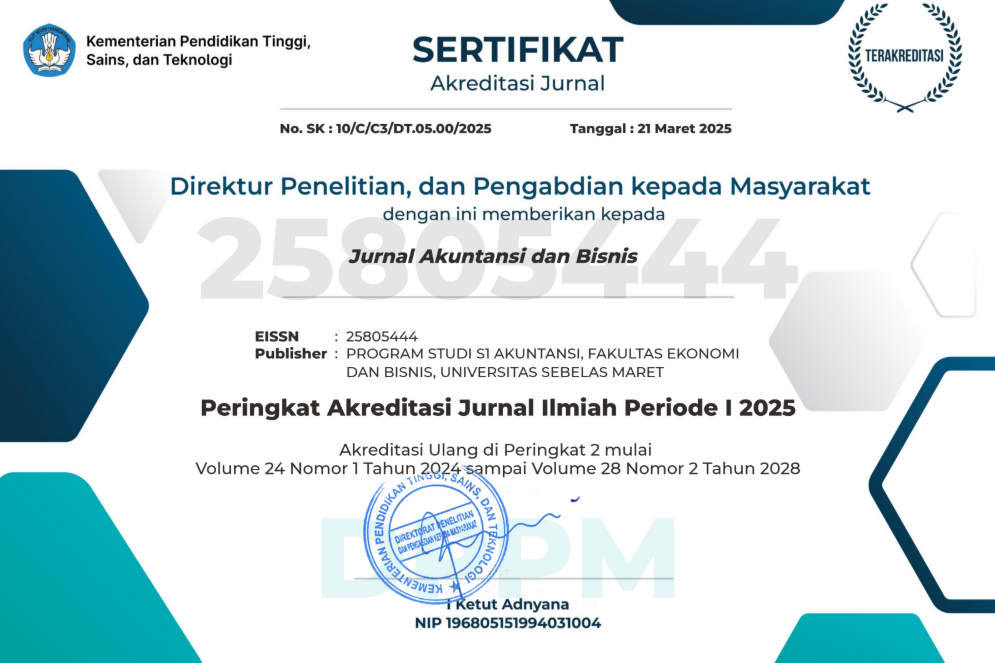
ISSN 1412-0852 (print), 2580-5444 (online)
Published by Accounting Study Program, Faculty of Economics and Business, Universitas Sebelas Maret, Indonesia

JAB on http://jab.fe.uns.ac.id/index.php/jab is licensed under a Creative Commons Attribution-ShareAlike 4.0 International License